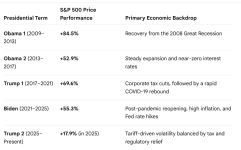
Claiming that 401(k) balances are "higher under Trump" than under Democratic presidents Obama and Biden is factually inaccurate.
While the stock market performed exceptionally well during Donald Trump's first term, the compounding nature of retirement savings means that average 401(k) balances have hit consecutive record highs over time.
Consequently, the average American's 401(k) balance was significantly larger at the end of Joe Biden’s term than it was at the end of Trump's first term.
The historical data breaks down across several metrics:
1. Actual Average 401(k) Balances (The Real Dollars)
Data tracking from Fidelity Investments—the nation’s largest 401(k) provider managing over 25 million accounts—directly refutes the claim:
- End of Obama’s Presidency (Q4 2016): The average 401(k) balance was roughly $92,500.
- End of Trump’s First Term (Q4 2020): Driven by tax cuts and a post-COVID market rebound, the average balance rose to $121,500.
- End of Biden’s Presidency (Q4 2024): Despite high inflation and interest rate hikes, a massive late-term artificial intelligence and tech bull market pushed the average balance to an all-time record of roughly $132,000.
- Trump's Second Term (Current 2026): According to Fidelity’s Q1 2026 Report, early-year market volatility tied to geopolitical tensions and tariff announcements caused a minor dip, bringing the average balance to $141,000 (up 14% since Biden left office in Q1 2021).
2. Stock Market Returns (The Growth Percentage)
If the claim is modified to mean "market growth was higher under Trump," the data still shows a remarkably even playing field between the administrations. When looking at S&P 500 total returns (which includes reinvested dividends), the historical performance sits remarkably close:
- Obama (Term 1): +100.1%
- Obama (Term 2): +63.4%
- Trump (Term 1): +81.3%
- Biden (Term 1): +66.3%
Trump's first term outpaced Biden's single term and Obama's second term, but trailed Obama's historically strong first term.
3. The Flaw in Political 401(k) Claims
Political rhetoric frequently exaggerates 401(k) movements to sway voters. For example, fact-checkers like PolitiFact investigated a claim by Trump that the typical 401(k) went up $30,000 during a 13-month stretch of his second term. Data from Fidelity revealed the actual average gain during that specific window was $9,454—showing that while accounts did grow, the political claims were heavily inflated.
The Bottom Line
Retirement accounts are designed to compound over decades. Because the broad stock market historically moves upward over long cycles, the "highest" 401(k) balances will almost always belong to the most recent president, regardless of their political party.









 Nonsense, Do explain where the DJIA was at the beginning and end of the Obama and Biden terms and how it was your 401k was down. Liar.